
The age of the student determines how we learn
I prefer to start beginners between age 4-8. (I can start three year olds, as well, but the parents need to be quite invested!) At this age, parents participate deeply in the lesson and daily home practice. We do this in an age appropriate way and develop a routine that fits your family. Obviously, a four year old will need much more help and parental support than a motivated 8 year old will! For children 9-12, the parent is involved in smaller ways, such as reminding to practice, taking videos during the lesson, etc. I don’t start beginners older than 12. Teenagers come to the lesson alone and practice independently.
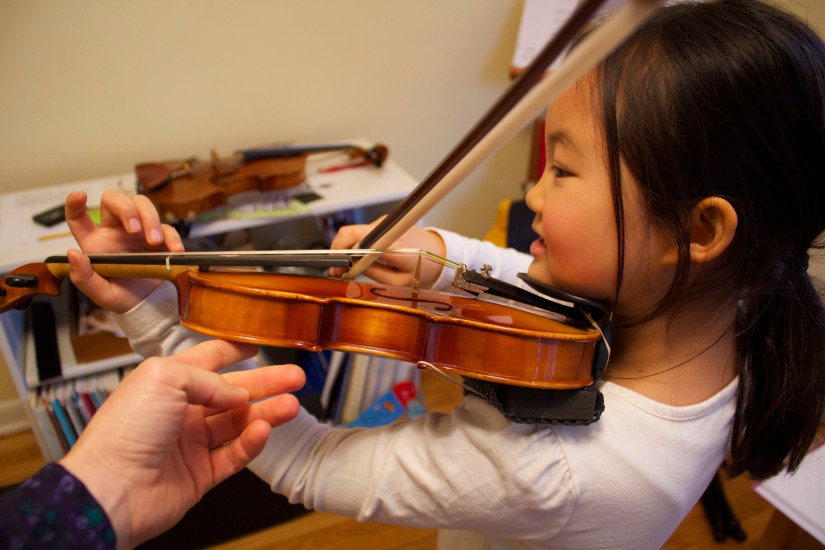
What’s involved? The Suzuki Method is an amazing, intentional, and–at times–challenging way to invest in your child. As a Suzuki parent, you’ll attend individual lessons and supervise home practice. And you won’t be in it alone: you, the parent, will also be my student! I’ll equip you with clear instructions and support you as we help your child realize his or her potential. You’ll also have connection to the other studio parents, as well as the network of the wider world of Suzuki.
How do we start taking Suzuki lessons? Read over this website a bit, contact me, and come over to watch a lesson. We’ll set up a time to talk on the phone or in person, then you can sign up. The first two lessons are for just the parent, then your child begins.
What’s a good age to start violin? How will I know if we’re ready? Kids are often excited to start violin. Our job is to create an environment where they can succeed and break down the learning into manageable pieces for them. So, the real question here is: are you, the parent ready? It’s like getting a puppy! Your child begs for a dog and promises, “I’ll feed and walk him every day!” Well, we all know that parents often take on the bulk of the responsibility and cost of raising a puppy, even if the children are really involved and eventually become competent, responsible dog owners themselves. Suzuki Violin is similar. Your child may be really excited to play music, but in the beginning years you will be 90% responsible for their success. Think about your daily life. Do you have the bandwidth to turn on the Suzuki Book recordings daily? What about setting aside a time to practice with your child daily? Can you make it to lessons on time with a clear mind? Their success in the early years lies in your willingness to commit to the process. Starting a child as young as 4 can be great, but it’s more labor intensive. You can also start later. There are many paths and I’m happy to discuss yours with you.
I’m not musical at all. Can I still be a successful Suzuki parent? Absolutely! The Suzuki Method works, and remember, you’re my student, too. My job is to meet you where you are and equip you to be a great home practice buddy and helper to your student. I provide you with very clear instructions and a user-friendly curriculum. I’ve had many wonderful students whose parents have no musical background — they trust me completely and follow my instructions. One advantage that musical parents have is the knowledge that good things come from patient practice, and the inspirational value of playing in groups and performing–but if you’re not a musician you can adopt that mindset, too.
Where do I get a violin? Talk to me before getting a violin, if possible. Students age 4 and under often start on a foam violin.
1. Renting. When you rent an instrument, go through a local violin shop if possible, like Quist Violins. The shop will often give you discounts and credit toward a future purchase. Thus, you’re likely to stay with the same shop.
2. Buying and selling. Buying can be more economical, but then when your child outgrows the instrument, have to trade in or sell it. Beware Craigslist deals unless you really know stringed instruments – one or two repairs on a run-down instrument can set you back $250 or more pretty quickly. Local shops sell quality instruments and sometimes do trade-ins. Big catalog companies like Shar and Robertson also have good trade-in and rent to own programs.
Where do I get recordings? Download here! https://www.alfred.com/suzuki-method/suzuki-audio-downloads/
DURING LESSONS
Arrive 5 minutes early. Arrive at your lesson a few minutes early and come straight downstairs basement. Please don’t leave any of your items on the main level of the house. Please use the basement bathroom to wash hands, then unpack as the lesson before you finishes. Your child will be responsible for carrying his or her instrument and getting it out.
What do I do during my child’s lesson? Suzuki parents are my students too! Your job during the lessons is to sit quietly, take notes, and watch the lesson carefully so you can replicate aspects of it during your home practice. Bring a tablet or phone with enough space for a short video or two – this will save you lots of time later when you’re at home wondering “how do we do that, again?” I will include you in the lesson when necessary, and debrief with you to make sure you feel clear about how to practice. You can always email with questions.
Only ONE teacher during the lesson–in other words, please remain quiet during the lesson unless I invite you to participate! Your child will learn best if there is only one adult teaching at a time. Let me do my job! I’ve taught hundreds of students and did a research study that involved reading subtle cues in students. I can tell when they’re one or two tries away from getting something; often, I’ll wait and give them a chance to work on it. Unfortunately, this is often the point where a well-meaning parent will interrupt with some instructions or comments for their child! Again, your child will learn best if you remain quiet and just observe. If I’ve just gone through a new or more complex topic, I’ll often take a moment to turn to you and explain what we’ve done, or offer you the chance to photograph or film the new skill. And–I know that students often play it perfectly at home then it changes the moment they arrive at their lesson. I still think you’re doing a fantastic job even if that happens. 🙂
Phones away. Please put your phone away during lessons. You may use it to take a video at the end, if needed.
Behavior expectations. I expect respectful behavior and an honest effort from all my students. I will deal with discipline issues during the lesson. I know you’re a great parent and that it’s frustrating if your child is tired or misbehaves, but please don’t intervene unless I ask you to. Usually, I like to give the child the benefit of the doubt for a bit. I will take some time to observe and decide what to do, before acting. I may correct them immediately, or I may wait and see what they do if I give them some space or change activities. In the case of repeated difficult behavior, I’ll talk to you outside the lesson and figure out how to proceed.
Challenges. Learning violin touches on all aspects of your life. Everyone struggles, even students who go on to become fantastic violinists. Please tell me immediately if things are difficult for more than a week or two. You are not a failure at all if your child refuses to practice, or melts down when you ask them to do what I taught them! My own children tend to behave much better for other teachers and adults 🙂 We will make adjustments and turn it into a learning experience. Often, small changes can make a big difference for a child. I’m here for you and am happy to consult you over email, phone, or Zoom to work toward solutions.
PRACTICING AT HOME
How much will I have to practice with my student?
All families practice daily for 15 minutes to start, and work up to practicing for about the same length as their lesson. Practicing is like exercising regularly: sometimes it’s enjoyable and satisfying, sometimes you just don’t feel like starting but you’re glad you did it, and sometimes you just need to get through it. The rewards are tremendous if you’re faithful. With regular practice and careful attention to my instructions, students enjoy the violin, improve every week, and play with beautiful sound and musicality. Conversely, students who do not practice make little progress, struggle to play, and wonder why the violin isn’t fun. 😦 I ask you to report your practicing to me every week. If you practice 3 or fewer times in a given week, your lesson will be a review lesson and we will repeat the same assignment for the following week. If you consistently miss practice, we will discuss whether Suzuki violin lessons are a good fit for your family.
I didn’t realize there would be so much technique and exercises involved with violin lessons. What’s with that?
Violin is a complex instrument, involving asymmetrical, cross-body movements, with the two hands engaged in separate tasks. Further, there are no frets on the violin, meaning that intonation must be carefully practiced. The learning curve on violin is steep, so I break it into small steps for young beginners. Learning poor habits in the beginning can be extremely challenging to fix later. I know this first-hand from my own journey as a player. I have made it my personal mission to teach the most quality technique possible from the start.
What if my child doesn’t want to practice? When will they become self-motivated? If my child cries during every practice, should we quit?
All families encounter these questions. Practice challenges are normal. It’s not a question of if you will have struggles, but when and how you deal with them! Here’s something to consider: children want to play the violin. They like music. But, they want to do it by magic! And, kids don’t like to be frustrated! It’s our job, as adults, to help them metabolize this frustration. You, the parent, are my student too, and it’s my job to help you help your child. We’re in it together. If you are feeling overwhelmed or uncertain about how things are going, reach out to me right away. I’m willing to provide email and phone support, and extra meetings for consultation if necessary. In the past, I’ve had students come to lessons for weeks with a smile, but then announce they’re quitting because practice had been hard for the past year. That was a learning moment for me: I want to know that sooner. If it helps, when I was a child I was quite stubborn about practicing. Often, the intrinsic motivation comes from the joy of performing, playing music with others, or learning a special piece, but the consistent work, love, and occasional struggle are part of the process too. Sometimes students do end up quitting, but everyone feels better if we discuss it and find a positive way to close lessons.

 Lisa Toner Studio